Haryana Jamabandi Website For Land Records And Services

Haryana Jamabandi Website For Land Records And Services - In Haryana for any kind of land record related information the citizen of the state need to log on to the official Jamabandi HALRIS website. They can easily access services such as property registration and deed registration status, mutation, court cases and status etc.
The state government has taken initiatives by providing the facility by digitalisation of records.
Read Also: Godrej Buy 33 Acre of Land in Bannerghatta Road Bangalore
Benefits Of The Haryana Jamabandi Online Portal:
- Accessible by all citizens of the state.
- An initiative to stop black marketing and black money.
- Ease of access and comfortable.
- Also, the availability of land documents ensures easy availability of loans.
What is Fard?
Fard refers to the records of rights (RoR) that contains the information about land, its ownership and even its cultivators, etc.
Read Also: DLF One Midtown
Read Also: Top 10 Best Luxury Apartments in Noida
Read Also: Loan Against Property In Noida
What Is Bhulekh?
Bhulekh is the blended term of two hindi words, ‘bhu’ (meaning land) and ‘lekh’ (meaning account). So, basically bhulekh means account of land and its details.
Bhulekh Haryana is the record of all lands and its owners in the Haryana state. The land owners and property investors in Haryana have to access the official Jamabandi portal, to get the bhulekh information for their land.
Read Also: TVS Emerald Singasandra Bangalore
Read Also: Godrej Pimpri Chinchwad Pune
Read Also: ATS Homekraft Rohini Delhi
Read Also: Max Sector 128 Noida
Read Also: Godrej Woodsville
Read Also: Paras Floret
Online Property Records by Bhulekh Haryana
If the user wants to get the land records documents in Haryana and would get all the information through the official Jamabandi website.
What is Jamabandi?
Jamabandi is a part of the record-of-right (RoR) and that establishes the ownership, cultivation and various other rights in land. The patwari prepares this Jamabandi document and revenue officer attests the same. Also, the patwari keeps one of the copies of the Jamabandi while the other is kept at the district record room.
The HALRIS includes the major components like
- Jamabandi
- Mutation
- Khasra Gridawari
- Roznamcha
- Jamabandi Consignment
- Jamabandi Nakal.
Read also: Top 10 Best Luxury Apartments in Gurgaon
Read Also: Buy Residential and Commercial Property in Noida
Read Also: M3M Sector 79 Gurgaon
Read Also: Smart World Sector 79 Gurgaon
How To View Jamabandi Nakal Online?
Step 1: First of all, go to the ‘Jamabandi’ tab on the homepage of Jamabandi official portal. Then, tap on it to go to ‘Jamabandi Nakal’.
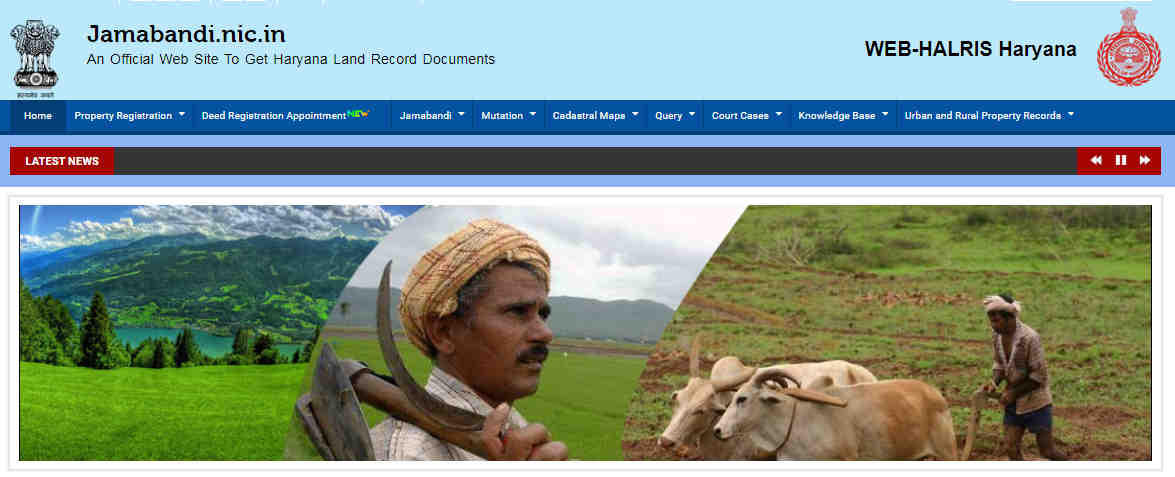
Step 2: The user can get the Nakal details by name of the owner, by khewat, by khasra/survey number or by the date of mutation.
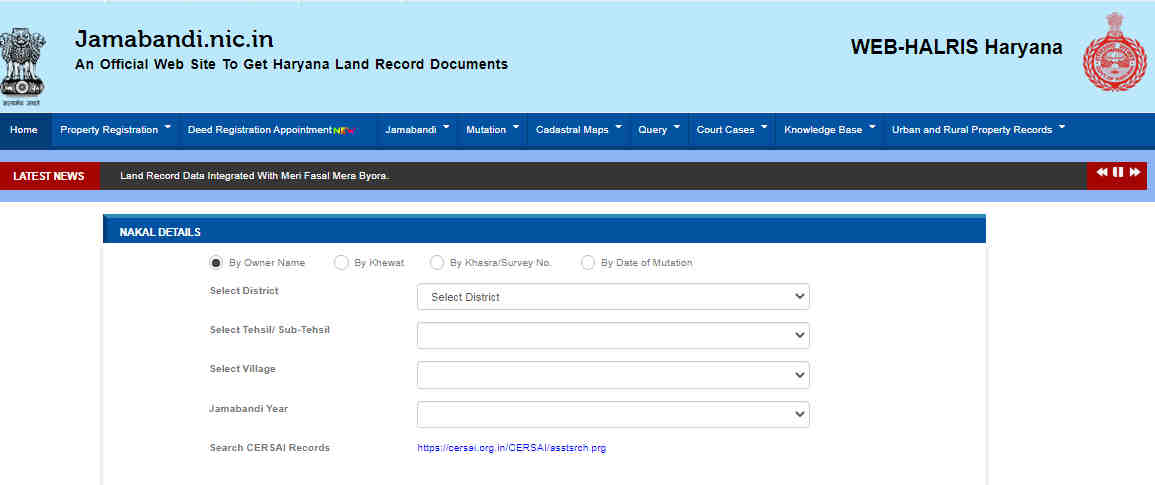
Step 3: Now, you have to click on any one to proceed and fill in the required details and proceed.
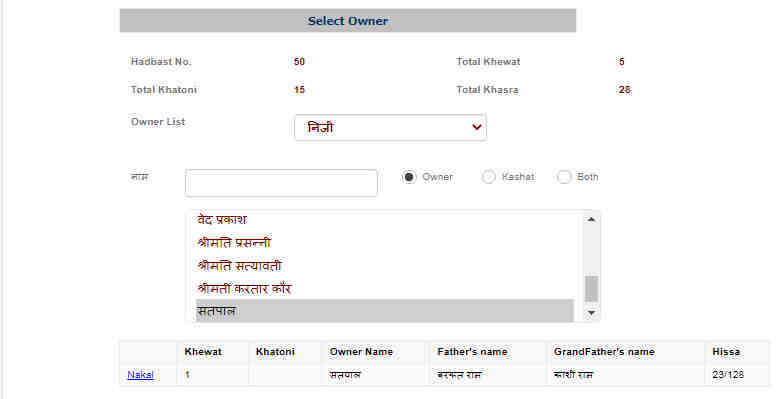
Step 4: Enter all the details that are relevant and once you input all the right details, the Nakal details will be displayed.
Read Also: TARC Kirti Nagar Delhi
Read Also: Top 10 Best Luxury Apartments in Pune
Read Also: Top 10 Best Luxury Apartments in Mumbai
Read Also: M3M Projects in Gurgaon
How To Search For Registered Deeds On The Jamabandi Website?
There are many kinds of deeds:
- Sale deed: Agricultural land or urban property.
- Mortgage deed: Without possession for agricultural land: Without possession for Plot/Flat/With possession for Plot/Flat.
- General Power of Attorney
- Transfer of property: Agricultural, house/shop, plot/house, plot/house lal dora/HUDA.
- Lease deed: Agricultural land, plot/house.
- Release deed
- Redemption of Mortgage
- Revocation of power of attorney
- Agreement
- Exchange
- Gift deed
- Surrender of lease
- Rent deed
The Jamabandi website can be used to check any of these and simply go to Property Registration > View registered deed. However, for any of the registry, you will have to book an appointment.
Read Also: Birla Sector 150 Noida
Read Also: M3M Sector 128 Noida
How To Check Deed Appointment Availability Online On Jamabandi?
Firstly, go to the Property registration tab on the main homepage and click on ‘Check Deed Appointment Availability’.
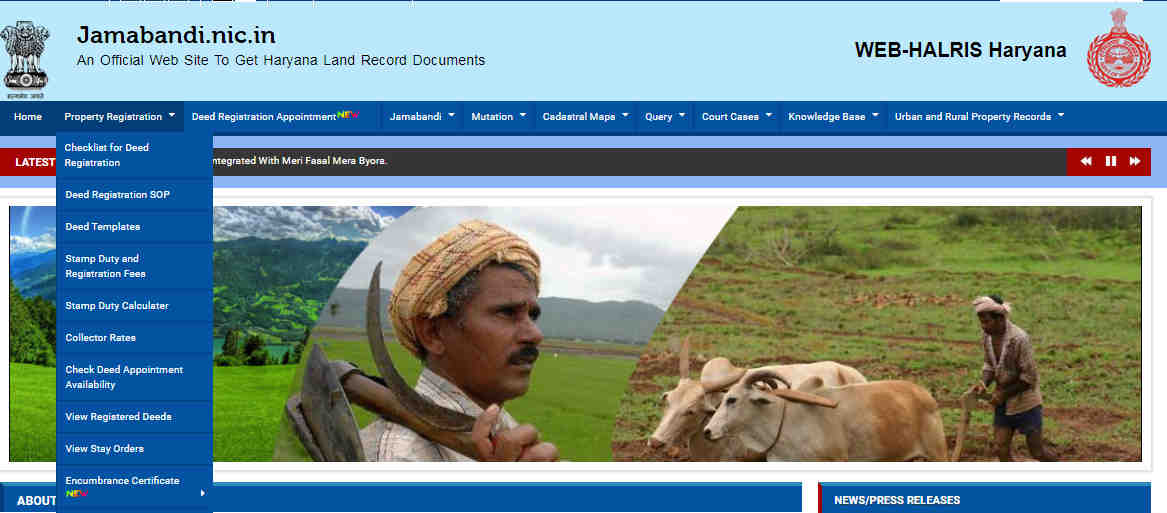
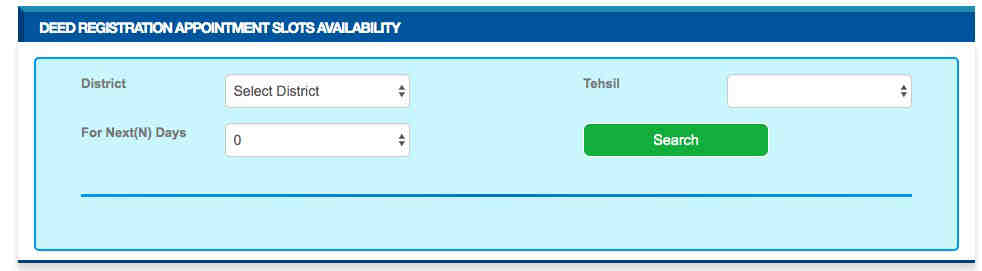
The, as per your choice get an appointment after entering the number of days and a list of appointment dates will be shown.
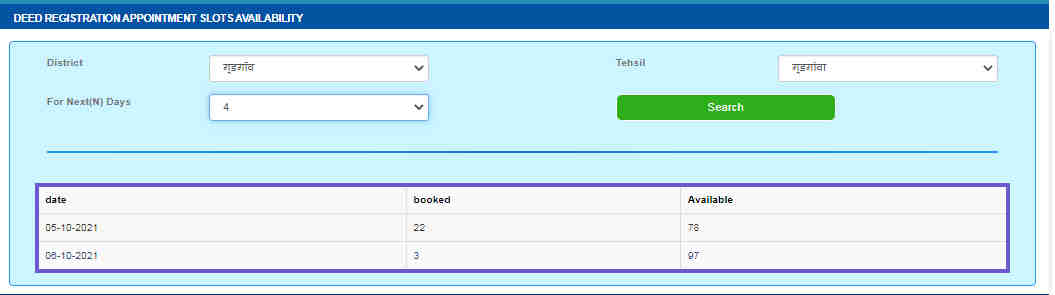
What Is The Alternate Way To Check Deed Appointment Availability?
Read Also: Smart World Sector 111 Gurgaon
Read Also: L and T Sector 150 Noida
Read Also: M3M Sector 111 Gurgaon
There is a new tab been introduced on the jamabandi website called as ‘Deed Registration Appointment’ on the official portal homepage. This is the simplest way from where you can Directly check for appointments.
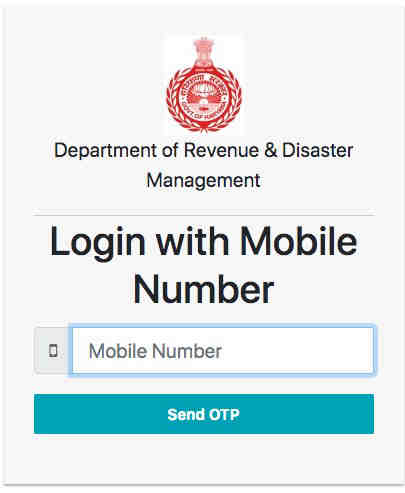
Now, the user will be asked to enter the respective phone number and once you enter the mobile number, you will receive an OTP. Now, simply key in the OTP in the space provided to proceed.
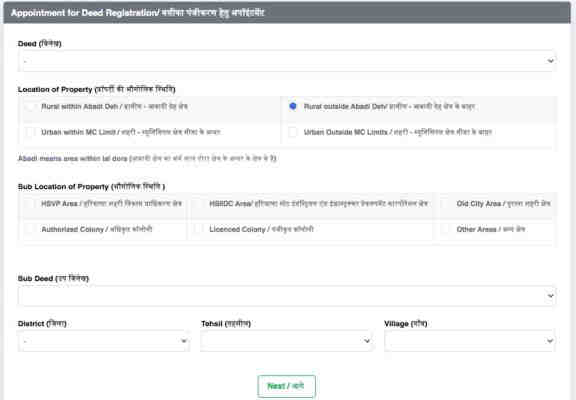
This process is more even more direct. You can simply select the deed you wish to register, for example, whether a lease, mortgage, partition, partnership, power of attorney, or sale deed, etc. Also, the user can select the relevant details from the drop-down menu.
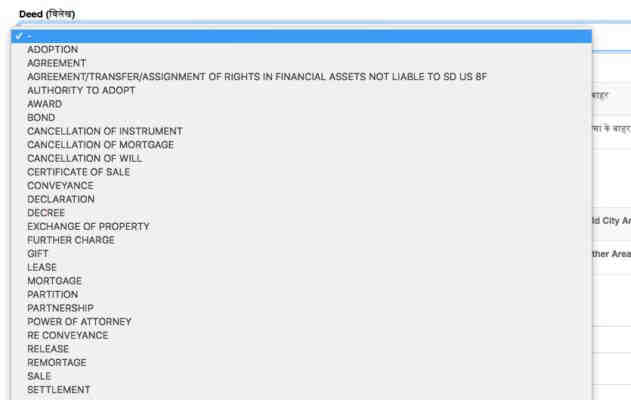
After that, the user will be asked to provide the location details of the property – ‘Rural within Abadi Deh’ or ‘Rural outside Abadi Deh’ or Urban within corporation limits’ or ‘Urban outside corporation limits’.
Then, further details are required for sub-location of property – whether a Haryana Shahari Vikas Pradhikaran area or Haryana State Industrial and Infrastructure Development Corporation area or old city area, authorised or licensed colony or whether the property falls under other areas. After that, provide details of the sub-deed, district, tehsil and locality.
Subsequently, you will be redirected to the next new page. The district, tehsil, village, category will now be filled automatically on the above details you had provided.
If you have the property ID, then you can enter it in the space provided. If you are provided with the municipal corporation and name of the owner, else further proceed to ‘Get Detail’. The details will be displayed and if the details are not displayed, you could visit the official website of the urban local body, Haryana and can easily generate a temporary ID.
Steps to Get Mutation Details on Jamabandi Website
Here’s how to check the mutation status of a property:
Firstly, use the ‘check mutation status’ option under the ‘mutation’ tab.
Secondly, fill in the district, tehsil and date to arrive at the correct data.
Thirdly, check the mutation nakal of the required property from the ones displayed as a result.
How To View Cadastral Map?
Cadastral maps refer to the geospatial land data pertaining to registered land parcels. It includes cadastral units, each of which denotes a single registered plot.
A user can view the cadastral map on the Jamabandi website. Just, visit the Jamabandi official website and on the home page, select ‘view Cadastral Map’.
Then, click on the Menu that is given on the top right corner, to look up for cadastral maps by clicking on Search Owners by Khasra or Khewat.
You will then have to select one out of the given options and then enter details such as district, tehsil, village, khasra or khewat, etc.
How To Check Revenue Court Orders On Jamabandi Website?
Step 1: Go to the ‘Court cases’ tab on the homepage.
Step 2: Click on ‘Revenue court status’.
Step 3: You will be redirected to another window. On your left hand side, a drop down list will give you the option of ‘view case status’.
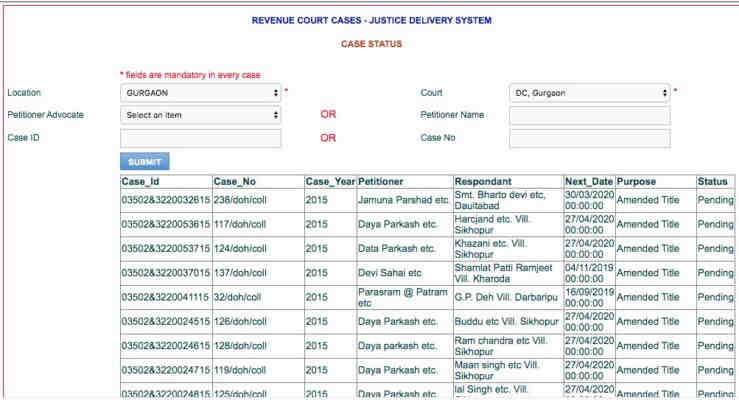
Step 4: Fill up the required details such as location, name of the advocate, court, case ID, etc.
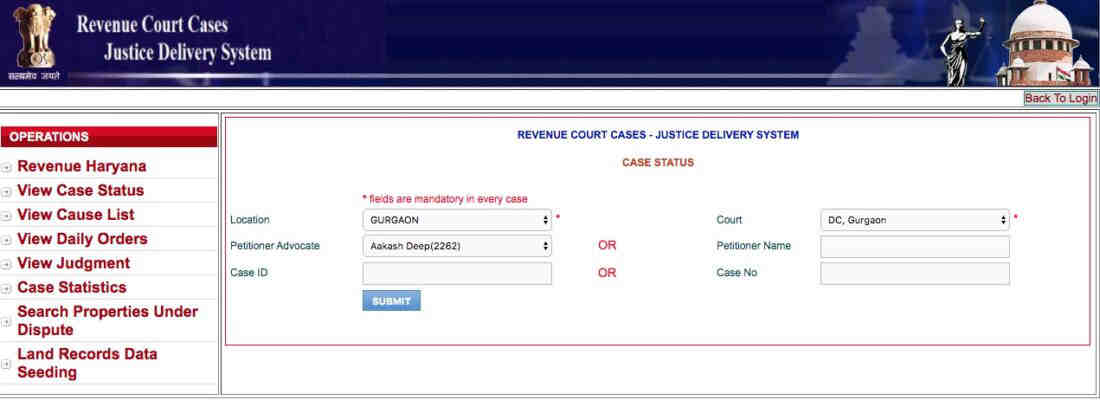
Step 5: Submit it to get the results.
How To Check Civil Court Cases On Jamabandi Website?
Step 1: Go to ‘Court Cases’>> Civil court cases
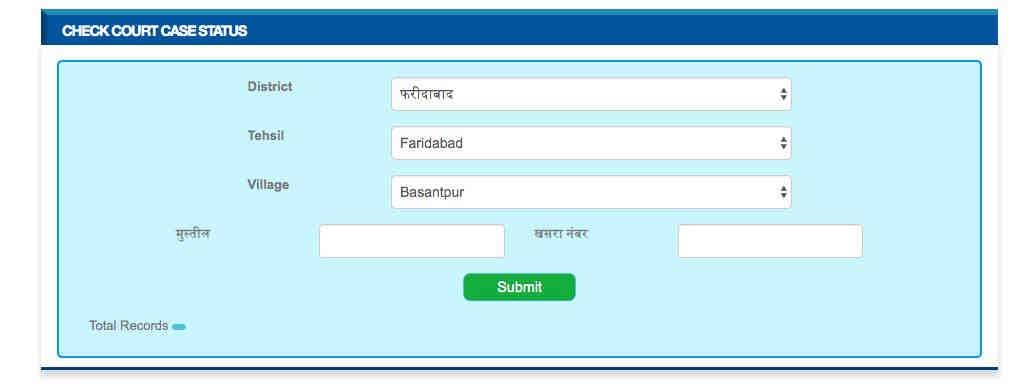
Step 2: Enter details such as district, tehsil, village, khasra number, etc., to view the status
How To Register Immovable Property On Jamabandi Website?
- Get all information, such as the price of the property as per the collector rate, stamp duty, registration, service fees, etc., from the sub-registrar’s office at the HARIS counter.
- For example: Consider that if the stamp paper value is below Rs 10,000, you can procure it from the stamp vendors. And, if it exceeds Rs 10,000 you will have to get it from the treasury office after making the payment at SBI.
- Two witnesses are required for the process; you can write the document by yourself or hire the services of a writer.
- Other important documents that are needed at this stage include the title deed, jamabandi, digital photograph and plan and map’s copy.
- Now, submit these documents, plus the stamp paper at the concerned sub-registrar’s office.
- You will have to make the payment of stamp duty and other charges will take place after this.
- The sub-registrar will inspect all the provided details and you will need to physically appear before the joint-sub registrar or the sub-registrar, for the entry of the document in the records.
How To Check Important Details About The Property On Jamabandi?
On the Jamabandi website, you can also find the following information:
- Owner details
- Kashatkar
- Makbuja
- Total land details
- Irrigation details
- Majrua or gair majrua land details
- Khewat/Khatoni details
For the above-mentioned details, just log on to the official website and proceed to ‘Query’ tab. After that, just proceed to input the required details.
Common Vernacular Words Associated With Land In Haryana
| Abadi Deh | In inhabitant site of village |
| Badastur | Unaltered |
| Banjar | Uncultivated land |
| Banjar Jadid | Land not cultivated for continuous four harvests, although it was cultivated earlier |
| Banjar Kadim | If continued to be uncultivated for the next four harvests |
| Barani | Dependent on rainfall |
| Bigha | A measure of area (varies from place to place) |
| Biswa | One-twentieth of a bigha |
| Biswansi | One-twentieth of a biswa |
| Chahi | Irrigated from well |
| Chahi Nahri | Irrigated partly from a well and partly from canal. |
| Chari | A kind of millet grown for fodder |
| Chaukidar | Village watchman |
| Chkota | Lump grain rent or rent consisting of a fixed amount of grain in the rabi and kharif. |
| Dholi | Death bed gift or a small plot of land to a brahmin. |
| Gair-Mumkin | Barren |
| Girdawar | Kanungo or supervisor of Patwaris |
| Girdawari | Harvest inspection |
| Gosha | Corner |
| Kalar | Barren land (sour clay) |
| Kanal | A measure of area |
| Kanungo | Supervisor of patwaris |
Karam Kharaba | Unit of length Portion of crop which has failed to come. |
| Kharif | Autumn harvest |
| Khasra | List of fields, field register |
| Khasra Girdawari | Harvest inspection register |
| Khata | Holding of tenant |
| Khatauni | Holding slips prepared at re-measurement |
| Khewat | A list of owner’s holding |
| Khewat/Khatauni | A combined Khewat & Khatauni |
| Khud Kashat | Cultivated by the owner himself |
| Killabandi | Rectangular measurement |
Latha Girdawari Marla | Cloth copy of the patwari’s map Measuring of area |
| Mauza | Village |
| Min | Portion / part |
| Misal Haqiyat | Record-of-right |
| Musavi | Mapping sheet |
| Nahri | Irrigated from canal |
| Naib-Tehsildar | The deputy or assistant of tehsildar |
| Parat Patwar | Patwari copy of the new settlement record |
| Parat Sarkar | Government copy of the new settlement record |
| Patwari | A village accountant or registrar |
| Sabik | Former |
| Sub-divisional magistrate | In-charge of a tehsildar |
| Taccavi | Loan granted by a government to a land owner for agriculture purposes. |
| Waris | Successor |
| Wasil Baqi Nawis | Revenue accountant in the tehsil |
| Wattar | Diagonal line |
| Zamindar | Land owner |
Units of measurement used in Haryana
Before settlement
1 Karam = 57.157″
1 Biswansi = 1 Karam x 1 Karam
20 Biswansi = 1 Biswa
20 Biswa = 1 Bigha
4 Bigha and 16 Biswa = 1 acre
Cooperative or mutual settlement
1 Karam = 57.157″
20 Biswansi = 1 Biswa
20 Biswa = 1 Bigha
4 Bigha = 1 Kila (40 Karam x 40 Karam)
After settlement
1 Karam = 66″
1 Sarsai = 1 Karam x 1 Karam
9 Sarsai = 1 Marka
20 Marla = 1 Kanal
8 Kanal = 1 acre
1 acre= 36 Karam x 40 karam (उतरसे दक्षिण, पुर्व से पश्चिम)
FAQs
Q. What services can be availed through the Jamabandi website?
Through the Jamabandi website, you can obtain information about property registration, jamabandi nakal, collector rates, mutation, cadastral maps, court cases, answers to almost all your land related queries.
Q. What does Jamabandi mean?
Jamabandi is the record of rights. The website defines it as ‘A document prepared as part of record-of-right in every revenue estate. It contains entries regarding Ownership, cultivation and up-to-date of various rights in land’.
Q. What is mutation?
On change of ownership, changes must be made in government records to reflect the change. This process is known as mutation.
Read Also:- What is circle rate? How does it impact a homebuyer?
Read Also:- Why the surge in demand for 3-4 BHK apartments in Kandivali, Mumbai?
Read Also:- What are the ways to deal with illegal property possession?
Read Also:- Delhi Mumbai Expressway Route, completion date and status
Read Also:- Investing in Smart homes? Know These Tips Before Investing
Read Also:- What Should You Consider While Buying Resale Property?
Read Also:- How To Use Feng Shui Principles To Buy A House?
Read Also:- What are The Top 7 ways to increase the value of your property?
Read Also:- How to pay commercial property tax?
Read Also:- An Easy Guide To Buying A Luxury Home
Read Also:- How to buy property in Lakshadweep?
Read Also:- How the investment changes are taking place in Proptech Sector? Get complete Insight
Read Also:- Buying Property From a Reputable Developer? Know the Advantages Now
Read Also:- Why Are Gated Communities Trending These Days?
Read Also:- Top Challenges For Consumers To Buy Their Dream Property
Read Also:- Top 10 Reasons To Invest In Mumbai
Read Also:- Top 8 Reasons To Move To Bangalore
Read Also: - Top 10 Best Residential Projects in Pune
Read Also:- Top 10 Best Residential Projects in Kharadi
Read Also: - Top 10 Best Residential Projects In Undri
Read Also: - Top 10 Best Residential Projects in Wagholi
Read Also: - Top 10 Best Residential Projects In Bangalore
Read Also: - Top 15 Best Residential Projects In Gurgaon
Read Also: Top 10 Best Residential Projects In Noida Extension
Read Also: - Top 10 Best Residential Projects In Sector-150 Noida
Read Also:- Top 10 Best Residential Projects in Noida
Read Also:- Top 10 Best Residential Projects in Wakad
Read Also:- Top 10 Best Residential Projects in Bavdhan
Read Also:- Top 10 Best Residential Projects in Nibm
Read Also:- Top 10 Best Residential Projects in Talegaon
Read Also:- Top 10 Best Low Rise Apartments in Gurgaon
Read Also:- Top 10 Best Residential Projects in Mamurdi
Read Also:- Top 10 Best Residential Projects in Gurgaon
Read Also:- Top 10 Best Residential Projects in Mumbai
Read also: Top 10 Best Commercial Property in Noida
Read Also: Top 10 Best Luxury Villas in Noida
Read Also: Top 5 Best Luxury Projects in Delhi
Read Also: Top 10 Best Luxury Projects in Bangalore
Read Also: Top 10 Best Luxury Projects in Gurgaon
Read Also: Top 10 Best Residential Projects In Chennai
Read Also: Top 10 Best Residential Projects in Dwarka Expressway Gurgaon
Read Also : Assetz Group Property Bangalore Real Estate Developer And Builder
Related Articles

Types Of Building Plans How To Design, Advantages
Types Of Building Plans How To Design, AdvantagesBuilding blueprints offer an image of how a structure will look when it is finished. Contractors and

What are Home Buyers expecting from Modi Government’s Maiden Budget?
What Are Home Buyers Expecting From Modi Government’s Maiden Budget?Expecting the now-fabled "achche din," homebuyers had high hopes for the first bud

Why are smart homes gaining popularity
Why Are Smart Homes Gaining Popularity?Technology is gradually permeating the nation's housing industry. The modern home buyer is becoming more and mo

Master Plan - What is it, Importance, Advantage & How it is made
Master Plan - What Is It, Importance, Advantage & How It Is Made?The city's long-term plans are called master plans. They therefore need to be com